Explore the islandPlaces
East Mallorca guide: Artà, Capdepera, the Llevant and Drach caves
The east is Mallorca at its least polished: a walled hill town, a castle above the sea, wild northeast coves inside a natural park and a cave lake on the coast. This is how we would spend time there.
 Placeholder image
The short answer
East Mallorca is best for walkers, swimmers and anyone who likes old towns more than resorts. Climb to the Sant Salvador sanctuary above Artà, see Capdepera castle, swim at Cala Torta or Cala Mesquida, walk in the Llevant natural park, then visit the Drach caves at Porto Cristo. Spring and early autumn are the best months.
Key takeaways
- Artà and Capdepera are the two historic hill towns: one has a walled sanctuary, the other a 14th century castle.
- Cala Torta and Cala Mesquida are the wildest beaches of the east; Cala Torta has no real facilities.
- The Llevant natural park was extended in 2023 and now covers about 17,100 hectares of land and sea.
- The Drach caves at Porto Cristo end with a live concert on Lake Martel; book a time slot online.
- Markets run almost every day of the week somewhere in the east, from Manacor on Monday to Porto Cristo on Sunday.
On this page
- What is east Mallorca like, and who does it suit?
- Which towns and villages in east Mallorca are worth knowing?
- Which are the best beaches and coves in east Mallorca?
- Where can you walk in the Llevant natural park?
- Where should you eat, and which markets are on in the east?
- Where should you stay in east Mallorca?
- How do you get to east Mallorca, and when should you go?
- What does one perfect day in east Mallorca look like?
East Mallorca is the island's quieter side: two hill towns crowned with walls, a natural park of bare ridges and empty coves, and a coast of small harbours and long bays. It suits walkers, cyclists and families who want a beach in the morning and a village square in the evening, rather than a scene.
The area runs from Artà and Capdepera in the northeast down through Sant Llorenç des Cardassar to Manacor and Porto Cristo. Base yourself in one of the inland towns and the whole of it is within half an hour's drive.
What is east Mallorca like, and who does it suit?
It is farming country that meets a rocky, varied coast. Inland you drive between almond and carob trees, dry stone walls and low hills; the coast alternates between resort bays such as Cala Millor and stretches with no building at all.
The east suits people who like to move: the Llevant hills are among the best walking on the island outside the Serra de Tramuntana, and a former railway line is now a car-free path for bikes. It suits families too, with shallow sandy bays and the caves at Porto Cristo. If you want beach clubs and nightlife, the southwest is a better fit; Cala Rajada is the one lively exception.
Which towns and villages in east Mallorca are worth knowing?
Artà is the one to plan around; Capdepera and Porto Cristo are the best half days. This table is where we would start.
| Town | Best for |
|---|---|
| Artà | Old town, the Sant Salvador sanctuary, Tuesday market, base for the Llevant |
| Capdepera | The castle, views over the northeast coast, Wednesday market |
| Cala Rajada | Harbour life, Cala Agulla, the easternmost lighthouse, evenings out |
| Manacor | The island's second town, Monday market, everyday shopping |
| Porto Cristo | The Drach caves, a sheltered harbour beach, Sunday market |
| Sant Llorenç des Cardassar | A quiet inland village, dinner, access to Sa Coma and Cala Millor |
Artà
Artà is a market town of honey-coloured stone stacked up a hill. At the top, inside battlemented walls, stands the Sant Salvador sanctuary, reached by a long stairway of about 180 steps from the parish church of the Transfiguració. The view from the walls takes in the town's rooftops, the Llevant hills and the bay of Alcúdia.
Less than a kilometre from the centre is Ses Païsses, a talaiotic settlement from Mallorca's prehistory, with a monumental stone gateway and a walk among holm oaks. The Tuesday market fills the streets around the centre.
Capdepera and Cala Rajada
Capdepera is a small town below a walled castle. Around 1300 King Jaume II ordered a fortified village to be built on the hill, and the walls, towers and chapel at the top are what remains. Each May, around the third weekend, the town holds its Mercat Medieval, with stalls, music and falconry in and around the castle.
Three kilometres down the road, Cala Rajada is a fishing harbour that grew into a resort. Walk out to the lighthouse at Cap de Capdepera, the island's easternmost point, and swim at Cala Agulla, the long pine-backed beach north of town. Sa Torre Cega, a villa above the harbour, has gardens with a collection of contemporary sculpture; visits are guided and booked ahead, so check before you go.
Manacor and Porto Cristo
Manacor is Mallorca's second town, a working place rather than a pretty one, best on a Monday morning when the market is on. Rafael Nadal grew up here, and his academy on the edge of town includes a museum about his career.
Its port, Porto Cristo, sits at the end of a narrow inlet with a small beach in the shelter of the harbour. Just outside it are the Drach caves: about 1,200 metres of chambers reaching a depth of 25 metres, ending at Lake Martel, one of the largest underground lakes in the world, where the visit closes with a live concert. Buy tickets online to secure your time slot.
Sant Llorenç des Cardassar
Sant Llorenç is a small inland village between Manacor and Artà, with a parish church, a few cafés and little else to do but slow down. Its municipality reaches the coast at Sa Coma and part of Cala Millor, separated by the Punta de n'Amer, a protected headland of pines and dunes with a late 17th century defence tower at its tip. It is also where we would book dinner in the east.
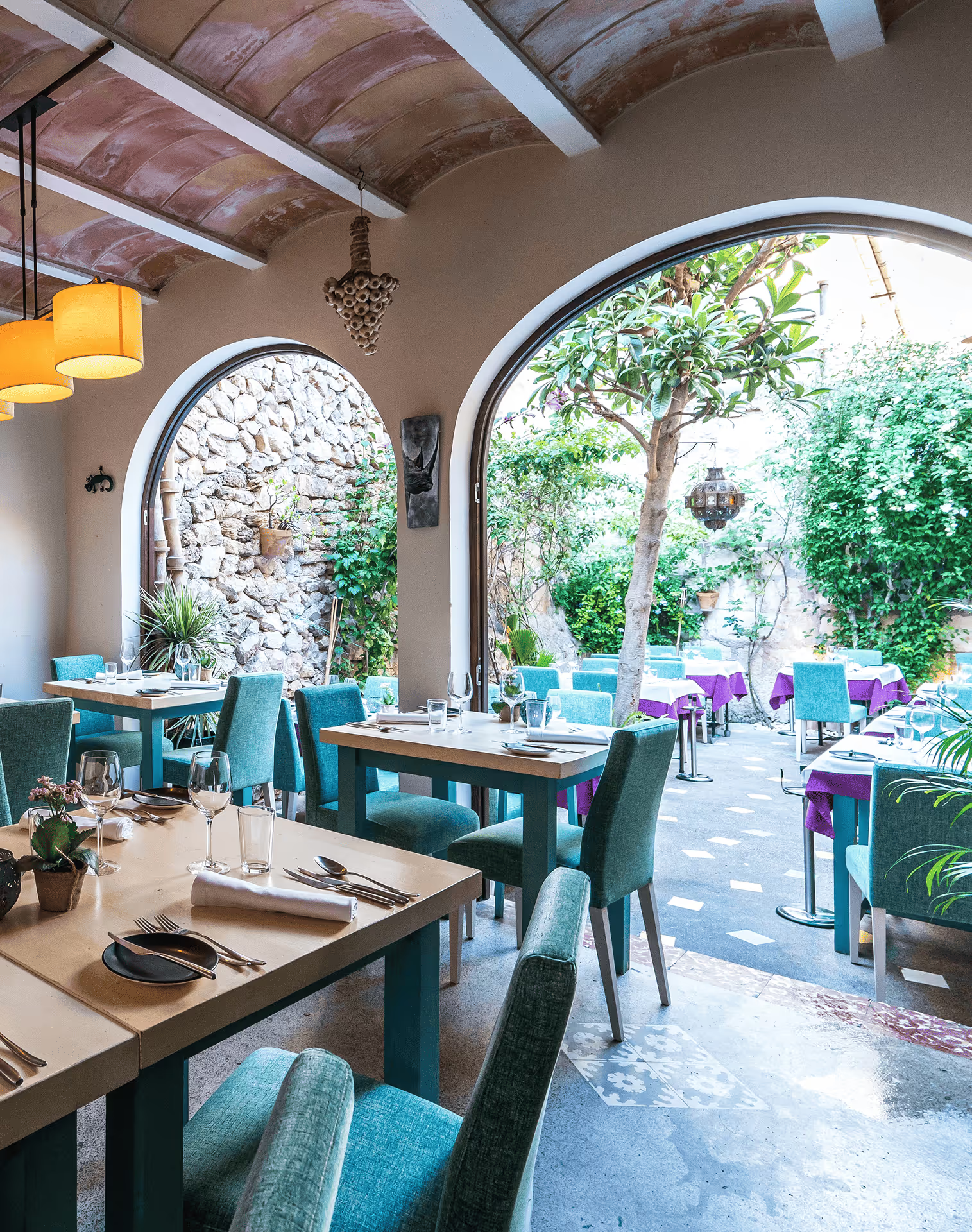
Surprise Menu Every Night · Sant Llorenç des Cardássar
Es Patí Restaurant
A village house in Sant Llorenç serving a five-course menu that changes every day, the best reason to stay inland for dinner.
Which are the best beaches and coves in east Mallorca?
For wild beaches, go to the northeast: Cala Torta and Cala Mesquida. For easy family swimming, choose Cala Agulla or the sandy bays of Sa Coma and Cala Millor.
- Cala Torta: a wide bay of coarse sand about 10 km from Artà, reached by the Racó road from beside the town's football pitch, then a rough final stretch. There are no real facilities, so bring water and shade.
- Cala Mesquida: a broad beach backed by dunes in the municipality of Capdepera. A coastal path from its western car park leads towards Cala Torta and the coves beyond.
- Cala Mitjana and Cala Estreta: two small coves next to Cala Torta, inside the public estate of sa Duaia and part of the natural park.
- Cala Agulla: Cala Rajada's main beach, long and sandy, with pines behind and the busiest of the four in summer.
- Sa Coma and Cala Millor: long sandy bays with shallow water on either side of the Punta de n'Amer, the practical choice with small children.
Where can you walk in the Llevant natural park?
The Llevant natural park covers the hills and coast north of Artà, and it is the east's best walking. It was created in 2001 and extended in 2023; it now covers about 17,100 hectares, of which roughly 10,900 are land, across Artà, Capdepera, Sant Llorenç and Santa Margalida. The highest summit is the Talaia Freda at 564 metres, followed by the Bec de Ferrutx.
There are more than 30 marked walking routes. Start at the s'Alqueria Vella information centre on the MA-3333 road out of Artà, which opens daily in the morning and early afternoon and lends audio guides. Several mountain refuges in the park, including S'Arenalet on the coast, are booked online through the Balearic government's refuge system. Access to the Talaia Moreia between 15 August and 15 January needs 48 hours' notice to the park office, so check before you go.
For something gentler, the Via Verda follows the old railway line between Manacor and Artà for about 29 km, through Son Carrió, Sant Llorenç and Son Servera. It is closed to cars and open to walkers, cyclists and riders, with restored stations along the way; a gravel or electric bike is better than a road bike.
Where should you eat, and which markets are on in the east?
Eat locally and simply at lunch, and book one proper dinner. Markets run somewhere in the east on almost every day of the week; this is the order we would use them in.
| Day | Town | Known for |
|---|---|---|
| Monday | Manacor | Large everyday market in the island's second town |
| Tuesday | Artà | Produce and crafts in the old town |
| Wednesday | Capdepera | Compact market below the castle |
| Friday | Son Servera | East coast market, easy from Cala Millor |
| Saturday | Cala Rajada | Busy resort market by the harbour |
| Sunday | Porto Cristo | Harbour market on the coast |
For the full island calendar, see our guide to Mallorca's weekly markets and the markets pages. Look out for local cheese, almonds, carob products and seasonal fruit from the farms inland.
For dinner, Es Patí in Sant Llorenç des Cardassar is our pick. There is no à la carte: Felix and his team cook a five-course menu that changes every day, drawing on traditional family recipes, international cooking and seasonal produce from the region, while Sarah runs the room and chooses wines from Mallorca and the Spanish mainland. In warm months you eat on the patio or the covered terrace. It opens in the evenings, Tuesday to Saturday, and takes a short break in November, so check before you go and mention vegetarian or allergy needs when you book. More addresses are in our restaurant selection.
Where should you stay in east Mallorca?
Stay inland if you want character, and on the coast if you want to walk to the sea. The countryside around Artà, Capdepera and Sant Llorenç has converted farmhouses and small rural hotels, many with pools, that make the best base for walking and the northeast coves. Cala Rajada and Porto Cristo have hotels within walking distance of a beach, and Cala Millor has the large resort hotels.
A car is close to essential if you stay in the countryside. Our hotel selection covers our recommended places to stay across the island.
How do you get to east Mallorca, and when should you go?
Drive. Artà is around an hour from Palma on the MA-15 through Manacor, and Porto Cristo a little less. A train runs from Palma to Manacor, and buses link the main towns, but the coves and the park need a car or a bike.
April to June is the best time: green hills, wildflowers, warm days for walking and the first swims. September and October bring the warmest sea and fewer people. July and August are hot and Cala Rajada is busy, so walk early and swim late. In winter the coast is quiet and many hotels close, but the hill towns and markets carry on.
What does one perfect day in east Mallorca look like?
Start in Artà, spend the middle of the day on the coast and finish with dinner in Sant Llorenç. On a Tuesday you also get Artà's market.
- Morning: climb to the Sant Salvador sanctuary in Artà for the view, then walk out to Ses Païsses.
- Late morning: drive to Capdepera and walk the castle walls.
- Lunch and afternoon: swim at Cala Mesquida, or at Cala Torta if the sea is calm, with a picnic.
- Late afternoon: drive down to Porto Cristo for the Drach caves; book the slot in advance.
- Evening: dinner at Es Patí in Sant Llorenç des Cardassar, booked ahead.
To combine the east with the south coast on a longer trip, read our guide to south Mallorca, and for the east's village festivals, our calendar of Mallorca's fiestas.
Places in this story
Surprise Menu Every Night · Sant Llorenç des Cardássar
Es Patí Restaurant
A village house in Sant Llorenç serving a five-course menu that changes every day, the best reason to stay inland for dinner.
Questions readers ask
Is Artà worth visiting?
Yes. Artà is one of Mallorca's most attractive inland towns, with the walled Sant Salvador sanctuary on its hilltop, the talaiotic settlement of Ses Païsses a short walk away and a lively Tuesday market. It is also the best base for walking in the Llevant natural park and for the coves of Cala Torta and Cala Mesquida.
What is the best beach in east Mallorca?
For an unspoilt bay, Cala Torta and Cala Mesquida in the northeast are the best, though Cala Torta has no real facilities. For families, Cala Agulla near Cala Rajada and the sandy bays of Sa Coma and Cala Millor are easier, with shallow water and services nearby.
How long does a visit to the Drach caves take?
The caves at Porto Cristo run for about 1,200 metres underground and the guided route ends with a live concert on Lake Martel, so allow around an hour inside plus time to queue and park. Buying tickets online secures your time slot. Check current times and prices on the caves' official website.
Do you need a permit to walk in the Llevant natural park?
Not for most walks: the park has more than 30 marked routes open to walkers. Overnight stays in the park's refuges are booked online, large groups need authorisation, and access to the Talaia Moreia between 15 August and 15 January needs 48 hours' notice to the park office.
How far is east Mallorca from Palma?
Artà is around an hour's drive from Palma on the MA-15 via Manacor, and Porto Cristo slightly less. A train runs from Palma to Manacor, with buses beyond, but a car is the practical way to reach the beaches and the natural park.
Sources and checks
About the author