Explore the islandPlaces
North Mallorca guide: Pollença, Alcúdia, Formentor and the bays
The north is the island's most complete corner: two old towns, two wide bays, the Formentor peninsula, a Roman city, a wetland full of birds and the Lluc sanctuary in the mountains behind. Here is how to put it together.
 Placeholder image
The short answer
North Mallorca centres on Pollença and Alcúdia. Climb Pollença's 365 Calvari steps and browse its Sunday market, walk Alcúdia's walls and Roman Pollentia, and swim in the bays of Pollença and Alcúdia. Reach Cap de Formentor by TIB bus 334 in summer, when private cars are restricted, then watch birds at S'Albufera and drive up to Lluc.
Key takeaways
- Pollença's market is on Sunday morning, Port de Pollença's on Wednesday and Alcúdia's on Tuesday and Sunday.
- In 2026, private cars were restricted on the Formentor road from 15 May to 18 October, 10:00 to 22:00; TIB bus 334 runs to the lighthouse.
- Alcúdia pairs 14th-century walls with Pollentia, the Roman city founded in 123 BC.
- S'Albufera is free to visit with a permit from the Sa Roca information centre.
- Lluc, home of the Mare de Déu de Lluc and the Blauets choir, is the north's mountain day out.
On this page
- What is north Mallorca like, and who does it suit?
- Which towns and villages in the north are worth knowing?
- Can you drive to Cap de Formentor, and when is it restricted?
- Which beaches in north Mallorca are the best?
- What are the best nature spots and walks in the north?
- Which markets should you visit, and where should you eat?
- Where should you stay in north Mallorca?
- How do you get around north Mallorca, and when should you go?
- What does one perfect day in north Mallorca look like?
North Mallorca is the island's most complete corner: two historic towns, Pollença and Alcúdia, set behind two wide bays, with the Formentor peninsula, the Tramuntana mountains and the S'Albufera wetland all close at hand. It suits families, walkers, cyclists and birdwatchers, and anyone who wants a beach in the morning and an old town square at night.
This guide covers Pollença, Port de Pollença, Formentor, Alcúdia and the bays, with S'Albufera and the Lluc sanctuary. For the mountains and villages to the west, see our Serra de Tramuntana guide.
What is north Mallorca like, and who does it suit?
Two bays define it. The Badia de Pollença is sheltered and calm, backed by mountains; the Badia d'Alcúdia is longer and more open, lined with fine sand. Between them sits Alcúdia's walled old town on its narrow neck of land.
Families tend to choose the Alcúdia side for its shallow sandy beaches. Couples and walkers often prefer Pollença for its old town and the mountains on the doorstep. Either works as a base for the whole area.
Which towns and villages in the north are worth knowing?
| Town | Best for | Good to know |
|---|---|---|
| Pollença | Old town, the Calvari steps, Sunday market | Summer music festival in the Sant Domingo cloister |
| Port de Pollença | A calm bay, seafront walks, the way to Formentor | Market on Wednesday morning |
| Alcúdia | Medieval walls and Roman Pollentia | Markets on Tuesday and Sunday |
| Port d'Alcúdia | Long sandy beach, families, ferries to Menorca | Busy in July and August |
| Cala Sant Vicenç | Small coves below the mountains | Part of the municipality of Pollença |
| Can Picafort | A seafront on the bay and open-air sculpture | Easy to pair with S'Albufera |
Pollença
Pollença is the north's most handsome town, a few kilometres inland from its port. Its landmark is the Calvari: 365 stone steps, one for each day of the year, lined with cypresses and fourteen crosses, climbing from beside the town hall to a small chapel with views over the town. On Good Friday, the figure of Christ is carried down the same steps in the Davallament.
Below the steps, the Pont Romà crosses the Sant Jordi stream; despite the name, it may be medieval rather than Roman. The Puig de Maria, a hill of about 330 metres just outside town, is a good short climb. In summer, the long-running Pollença music festival fills the cloister of the old Sant Domingo convent, and on 2 August the town's fiesta of La Patrona stages its battle of Moors and Christians; our Mallorca fiestas calendar has the year's dates.
Pollença has long drawn artists. The painter and sculptor Joan Bennàssar was born here in 1950 and, after years in Barcelona, London, Paris and Mexico, came home in the 1990s. You can see his large figures in The new Ithaca of the Mediterranean, a permanent sculpture exhibition in Can Picafort, Son Serra de Marina and Santa Margalida. More island artists are in our art pages.
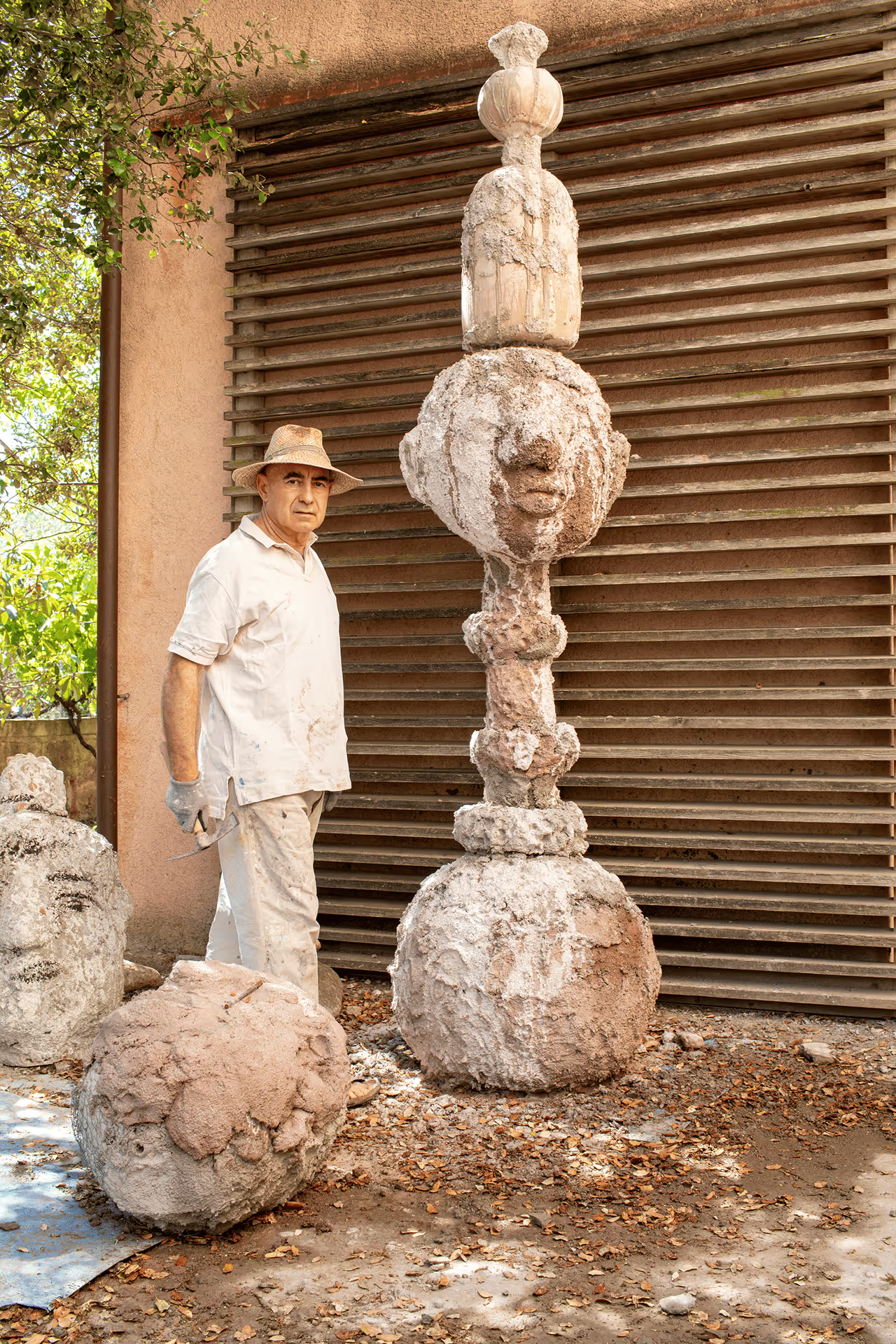
Mallorca's Finest Artist · Artist
Joan Bennàssar
Pollença-born painter and sculptor whose permanent open-air sculpture exhibition runs through Can Picafort and Son Serra de Marina.
For something to take home, Teixits Vicens has woven roba de llengües, Mallorca's ikat cloth, since 1854. Its artisan factory and shop are on the edge of town at the Can Berenguer roundabout; check opening times before you go, and see our shopping partners for more.
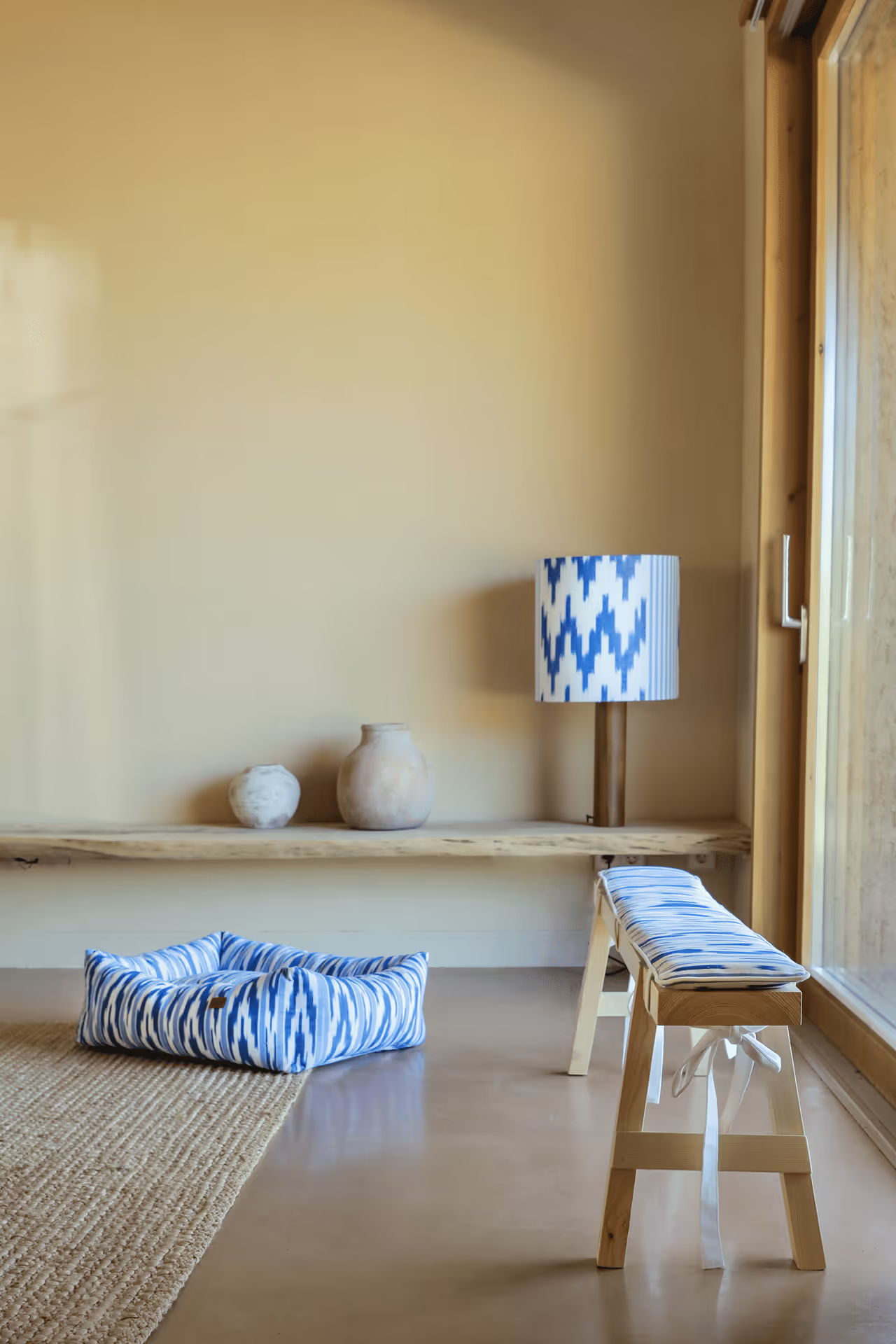
Historic Ikat Textile Tradition · Pollença
Teixits Vicens
Five generations of weaving Mallorca's traditional ikat cloth, with a factory shop in Pollença.
Port de Pollença
Port de Pollença is the calmer of the north's resorts, with a seafront under the pines and shallow water in the bay. The Wednesday market sets up on Plaça Miquel Capllonch by the church, and the walk up the Boquer valley is the classic short hike from the port. For a coffee or a long lunch, Cappuccino Grand Café, one of our partners, is on Anglada Camarasa and open daily from morning until late.
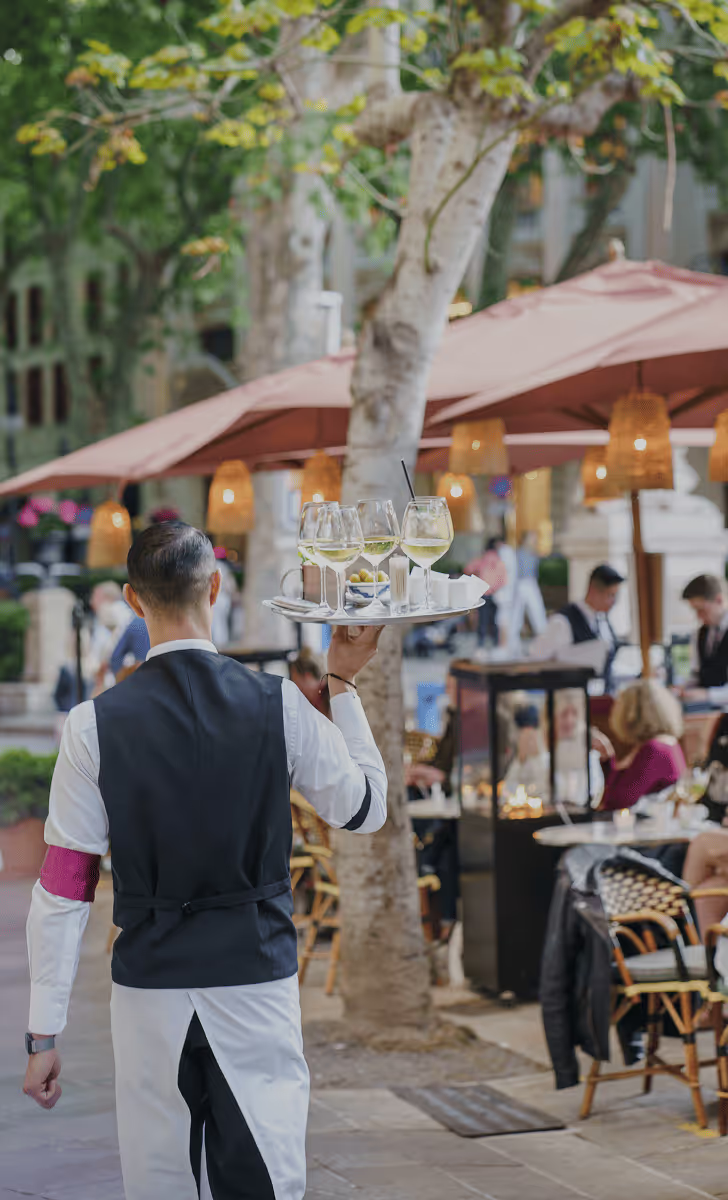
Always The Right Spot · Palma / Puerto de Andratx / Puerto Portals / Puerto Pollença / Valldemossa
Cappuccino Grand Café
The group's Port de Pollença café, open every day from breakfast to dinner, an easy stop before or after Formentor.
Alcúdia and Pollentia
Alcúdia's old town sits inside 14th-century walls, with the moat still in place and gates such as the Porta del Moll. Just outside lie the remains of Pollentia, the Roman city founded in 123 BC. You can walk through the La Portella residential quarter, the forum with its temple to Jupiter, Juno and Minerva, and the 1st-century theatre. The finds are shown in the Museu Monogràfic de Pollentia in the old town; check opening times before you go.
Can you drive to Cap de Formentor, and when is it restricted?
Outside summer, yes. In summer, private cars are restricted on the Formentor road, and the lighthouse is reached by bus, bicycle or on foot. In 2026 the restrictions ran from 15 May to 18 October, every day from 10:00 to 22:00, according to the DGT, Spain's traffic authority.
- To Formentor beach: private cars may drive to the beach car park without a permit until it is full; after that, a barrier near Port de Pollença lets only authorised vehicles through.
- To the lighthouse: beyond the beach, only authorised vehicles, bicycles and the shuttle bus may pass.
- By bus: TIB line 334 runs from Alcúdia and Port de Pollença to the lighthouse, stopping at the Mirador des Colomer, Formentor beach and Cala Figuera.
The dates are set each year, so check the DGT before you go. Out of season, drive early: the road is narrow, the viewpoint car parks are small and the cliffs look their best in morning light or at sunset.
Which beaches in north Mallorca are the best?
For long sand and shallow water, go to the Badia d'Alcúdia; for calm and shade, the Badia de Pollença; for clear water and a setting, Formentor and Cala Sant Vicenç.
- Platja d'Alcúdia and Platja de Muro: the long sandy sweep of the Badia d'Alcúdia, shallow and easy with children.
- Port de Pollença: narrow sandy beaches along a calm bay, good for paddling and paddleboards.
- Formentor beach: a pine-backed beach on the peninsula; arrive early in summer.
- Cala Sant Vicenç: small coves of clear water below the mountains.
- Can Picafort: a seafront resort further round the bay, with Bennàssar's sculptures to walk past.
What are the best nature spots and walks in the north?
S'Albufera, behind the Badia d'Alcúdia near Port d'Alcúdia, has been a natural park since 1988 and covers about 2,036 hectares. It is a wetland of international importance under the Ramsar convention and one of the island's best places for birdwatching, with hides along flat paths. Entry is free, but you collect a permit at the Sa Roca information centre on arrival. The park opens from 9:00 to 18:00 between April and September and from 9:00 to 17:00 between October and March, and bicycles are allowed on the access routes at low speed.
In late October 2026 the park was closed for work on its paths and hides until 2 November, so read the notice on the official page before you go.
Lluc, in the mountains of Escorca, is Mallorca's spiritual heart. The sanctuary keeps the Mare de Déu de Lluc, honoured in 1894 as queen and patron of Mallorca, in a basilica built between 1622 and 1691 and restored in the early 20th century by Antoni Gaudí. Its choir, the Blauets, has been part of sanctuary life since the 16th century. There is a museum, a botanical garden of native plants and simple rooms around the old courtyard for an overnight stay.
Lluc is also a walkers' crossroads. The GR 221 passes the Son Amer refuge near the sanctuary and ends at the Pont Romà refuge in Pollença. Closer to the coast, the Boquer valley from Port de Pollença and the climb up the Puig de Maria are the easy classics.
Which markets should you visit, and where should you eat?
Plan a Sunday around Pollença: its market of around 300 stalls fills Plaça Major and the old streets. Arrive before 9:00 for parking.
| Day | Town | Where |
|---|---|---|
| Tuesday morning | Alcúdia | Beside the old town walls, near Pollentia |
| Wednesday morning | Port de Pollença | Plaça Miquel Capllonch, by the church |
| Sunday morning | Pollença | Plaça Major and the old town streets |
| Sunday morning | Alcúdia | Beside the old town walls, near Pollentia |
For every market on the island, day by day, see our guide to Mallorca's weekly markets, and our markets pages for food halls and producers. To eat, look for fish by the water in Port de Pollença and Port d'Alcúdia, and for an evening table on or near Pollença's Plaça Major.
Where should you stay in north Mallorca?
Choose Pollença's old town for character and evenings on the square, Port de Pollença for a calm bay and the shortest trip to Formentor, and Alcúdia for families who want sand on the doorstep. A rural estate in the valleys around Pollença gives you privacy, and the rooms at Lluc suit walkers. Our hotel selection covers places to stay across the island.
How do you get around north Mallorca, and when should you go?
The Ma-13 motorway runs from Palma towards Alcúdia, which makes the north an easy drive from the airport. TIB buses link Palma with Pollença, Port de Pollença and Alcúdia, and in summer line 334 runs out to Formentor. A car is still the easiest way to reach Lluc and Cala Sant Vicenç. From Port d'Alcúdia, ferries cross to Ciutadella in Menorca in just over an hour.
May, June, September and October are the best months: the sea is warm, restaurants are open and the roads are quieter. July and August are busy around the bays. In winter the old towns and markets keep going while many resort hotels close; it is the season for walking, cycling and birdwatching. Check before you go.
What does one perfect day in north Mallorca look like?
- 8:30 Pollença's Sunday market, then the Calvari steps before the heat.
- 11:30 Out to Formentor by car or bus: the Mirador des Colomer, the lighthouse, then a swim at Formentor beach.
- 14:30 A late lunch facing the bay in Port de Pollença.
- 16:30 Alcúdia: walk the walls and see the Roman theatre at Pollentia in softer light (check closing times).
- 19:30 Back to Pollença for an aperitif on Plaça Major and dinner in the old town.
Places in this story
Mallorca's Finest Artist · Artist
Joan Bennàssar
Pollença-born painter and sculptor whose permanent open-air sculpture exhibition runs through Can Picafort and Son Serra de Marina.
Historic Ikat Textile Tradition · Pollença
Teixits Vicens
Five generations of weaving Mallorca's traditional ikat cloth, with a factory shop in Pollença.
Always The Right Spot · Palma / Puerto de Andratx / Puerto Portals / Puerto Pollença / Valldemossa
Cappuccino Grand Café
The group's Port de Pollença café, open every day from breakfast to dinner, an easy stop before or after Formentor.
Questions readers ask
Is Pollença or Alcúdia better to stay in?
Pollença suits couples and walkers who want an old town, good restaurants and the mountains close by, with Port de Pollença for a calm bay. Alcúdia suits families, with long shallow sandy beaches on the Badia d'Alcúdia and a walled old town nearby. They are close enough that you can see both from either base.
Can you drive to the Formentor lighthouse?
Outside summer, yes. In 2026, private cars were restricted on the Formentor road from 15 May to 18 October, between 10:00 and 22:00: cars could reach the Formentor beach car park until it filled, but only authorised vehicles, bicycles and TIB bus 334 could continue to the lighthouse. The dates are set each year by the DGT, so check before you go.
What day is Pollença market?
Pollença's market is held on Sunday mornings, with around 300 stalls on Plaça Major and the surrounding old town streets. Port de Pollença has its own market on Wednesday mornings. Arrive before 9:00 to find parking.
Do you need a permit to visit S'Albufera?
Yes, but it is free. Collect it at the Sa Roca information centre when you arrive; it comes with a map and the park rules. Group visits need a special permit requested in advance.
Is Lluc worth visiting?
Yes, for its setting in the mountains, the basilica of the Mare de Déu de Lluc, patron of Mallorca, and the Blauets choir. There is a museum, a botanical garden and rooms for an overnight stay. It is also a starting point for walks on the GR 221.
Sources and checks
- DGT: traffic regulation on the Formentor road, 2026
- Govern de les Illes Balears: Parc Natural de s'Albufera de Mallorca
- Ajuntament de Pollença: El Calvari
- Ajuntament de Pollença: Port de Pollença market
- Illes Balears tourism: Pollença market
- Illes Balears tourism: Pont Romà de Pollença
- Illes Balears tourism: Alcúdia
- Illes Balears tourism: walls of Alcúdia
- Illes Balears tourism: Alcúdia market
- Illes Balears tourism: Roman city of Pollentia
- Ajuntament d'Alcúdia: Pollentia
- Santuari de Lluc
- Spain.info: Pollença International Music Festival
- Consell de Mallorca: refuge booking
- Joan Bennàssar: biography and projects
- Joan Bennàssar: The new Ithaca of the Mediterranean
- Teixits Vicens
- Cappuccino Grand Café: Port de Pollença
About the author